Munsell color system: hue, value and chroma, charted for the 12 seasons
The Munsell color system describes any color with three qualities: hue (the name of the color), value (how light or dark it is) and chroma (how strong it is). Color analysis uses the same three ideas for undertone, depth and chroma. Pick a season below to see its palette on a value by chroma chart and on a hue ring.
By Ruslan ShchuchkinML engineer and data scientistPublished
Munsell color chart: a season palette by value and chroma
Pick a season. Each dot is one color of its palette, plotted by lightness and chroma, with a hue ring below.
Across the 12 palettes, the mean lightness runs from L* 36 (Deep Autumn) to 79 (Light Spring), and the mean chroma from C* 15 (Soft Summer) to 79 (Bright Spring). Soft Autumn has a mean L* of 60, which is 7th lightest of 12, and a mean C* of 24, which is 10th strongest of 12.
The numbers behind the dots
| Color | L* | C* | Hue angle |
|---|---|---|---|
| Salmon | 65 | 36 | 40° |
| Soft terracotta | 56 | 40 | 39° |
| Muted rust | 51 | 42 | 45° |
| Warm rose beige | 65 | 28 | 46° |
| Dusty brick | 57 | 22 | 22° |
| Soft mulberry | 53 | 25 | 2° |
| Warm mushroom | 53 | 11 | 66° |
| Soft gold | 70 | 35 | 86° |
| Wheat | 77 | 35 | 89° |
| Moss gold | 64 | 35 | 97° |
| Sage green | 58 | 28 | 115° |
| Olive | 50 | 21 | 126° |
| Muted forest | 49 | 14 | 160° |
| Soft teal | 57 | 14 | 176° |
| Dusty blue | 62 | 12 | 231° |
| Slate blue | 48 | 13 | 258° |
| Soft plum rose | 63 | 17 | 352° |
| Soft peach beige | 79 | 17 | 68° |
| Pecan | 53 | 20 | 68° |
| Rosewood | 69 | 15 | 52° |
See Soft Autumn on a face
Free for your best and worst palette. All 12 in the full report.
The Munsell color system: three qualities
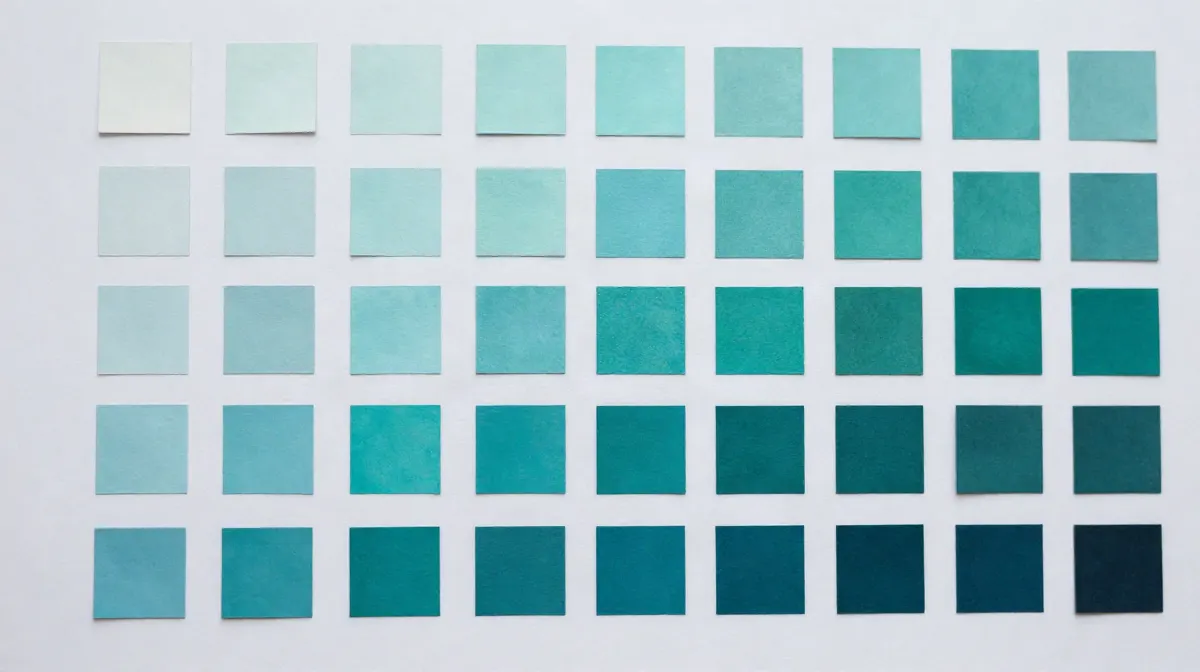
A. H. Munsell described any color with three qualities: hue, value and chroma [1]. Color analysis keeps the same three ideas and gives them the names people use when they shop.
- Hue
- The name of the color: red, yellow, green, blue and so on. In color analysis the hue lean of the skin is the undertone, warm or cool.
- Value
- How light or dark the color is. In color analysis this is depth, from light to deep.
- Chroma
- How strong the color is, from grey to vivid. In color analysis it is how bright or soft the coloring is.
The idea is the same on a face and on a sweater, so one set of words can describe both. Read the wider picture in color theory for clothes and skin tone.
Reading the Munsell color chart on this page
A Munsell color chart arranges colors by those three qualities. Ours does the same job with CIELAB numbers: lightness L* goes up the side and chroma C* goes along the bottom. Hue is not on this chart. The ring shows it.
The seasons separate on it in a way you can see. The strongest Soft Summer color has a C* of 28, and the softest Bright Spring color has a C* of 45. Across the 12 palettes, the mean lightness runs from L* 36 (Deep Autumn) to 79 (Light Spring). The palette colors themselves reach from L* 22 in Deep Autumn to L* 90 in Light Spring.
Munsell color wheel: the hue ring
A Munsell color wheel puts hue in a circle. The ring in the demo does the same with the CIELAB hue angle, which is worked out from a* and b*. Zero degrees points to the red-pink side, 90 to yellow, 180 to green and 270 to blue.
A season palette is not one hue. Each of the 12 palettes has colors in 8 to 12 of the 12 sectors of the ring. Undertone is a lean in hue, not a range of hues you are allowed to wear. See warm vs cool colors and the color wheel for clothes.
The 1943 renotation
In 1943 a committee of the Optical Society of America published the revised spacing of the Munsell colors, called the renotation [2]. We cite it for the date and the name only. This site does not use Munsell notation, and it does not claim that any palette color has a particular Munsell number.
From Munsell to CIELAB: what our analysis measures
The CIE publishes the standard that defines CIELAB, which describes a color with three numbers: L*, a* and b* [3]. L* is lightness. Chroma C* comes from a* and b*, and so does the hue angle. L* is close to Munsell value and C* is close to Munsell chroma in meaning. They are not equal, and we never convert one to the other.
| Munsell quality | Color analysis | CIELAB number | Our analysis scores |
|---|---|---|---|
| Hue | Undertone | hue angle | The temperature axis, cool to warm |
| Value | Depth | L* | The value axis, deep to light |
| Chroma | Chroma | C* | The chroma axis, soft to bright |
Our chroma axis is mostly not the C* of one color. When our analysis can see the hair, 70% of that axis is the lightness gap between hair and skin, which is the contrast trait, and 30% is the chroma of the skin. The axis keeps the name chroma, and the charts above plot the C* of palette colors, not that axis.
What the evidence does not support
- That the value and chroma of a color tell you what suits a face. They describe the color. In one study, observers chose warmer, more saturated and darker clothing for faces with darker eyes, and skin color had little effect [4].
- That a color system proves the seasons. The authors of one study note that the categories stylists build from skin, hair and eye color are not scientifically defined [5]. We found no peer-reviewed study that tests whether seasonal color analysis is valid.
What this chart cannot tell you
- It cannot give you a season. It plots palette colors. It does not look at a face.
- It is Munsell-style, not Munsell. The numbers are CIELAB, and the colors are the ones in our dataset, picked for clothes. They were not measured from paint chips.
- Your screen shows a limited range of color (sRGB), and screen settings change how every dot looks. The numbers do not change.
- The mean of a palette is one number for 20 colors. Two palettes with the same mean can look quite different.
- For your own result, use a photo in daylight. How it works and how often it is right.
How we made this
Each palette hex in lib/seasons.ts is read into CIELAB with lib/color.ts. L* is the lightness, C* is the length of (a*, b*), and the hue angle is atan2(b*, a*) in degrees. The mean L* and C* of each palette are the ones from lib/traits.ts, and the dashed box on the second chart is their range over the 12 seasons.
The ring segments are colors made at a fixed lightness and chroma and fitted to the screen range. A palette color with a C* under 8 is close to grey, has no hue worth placing, and stays off the ring. When two dots would overlap, one steps outward to the next lane. Hue angle and position are all that the ring shows.
Sources
- Munsell, A. H. (1905). A Color Notation. Boston: Munsell Color Co. openlibrary.org/works/OL1560367W
- Newhall, S. M., Nickerson, D., & Judd, D. B. (1943). Final report of the OSA Subcommittee on the Spacing of the Munsell Colors. Journal of the Optical Society of America, 33(7), 385. doi.org/10.1364/JOSA.33.000385
- CIE (2018). CIE 015:2018 Colorimetry, 4th Edition. Vienna: Commission Internationale de l'Eclairage. doi.org/10.25039/TR.015.2018
- Perrett, D. I. (2025; online first 23 Oct 2023). Eye color is more important than skin color for clothing color aesthetics. Psychology of Aesthetics, Creativity, and the Arts, 19(5), 1099-1110. doi.org/10.1037/aca0000626
- Perrett, D. I., & Sprengelmeyer, R. (2021). Clothing aesthetics: Consistent colour choices to match fair and tanned skin tones. i-Perception, 12(6), 1-22. doi.org/10.1177/20416695211053361
How this is different from other color analysis tools
- 01
Your photo stays on your device
Many photo apps upload your selfie and read it on their server (see our comparison). Ours measures it in your browser. There is no upload.
- 02
The result is free
Your season and palette, with no account and no email. At least one app in our comparison takes payment before you see any result.
- 03
A close call says so
Every result names the runner-up season and how close the call was. Borderline is a result we print.
- 04
We publish our accuracy
We tuned the method on faces that experts had labelled by season, then tested it on 410 celebrity photos we collected. The results, misses included.
Questions
What is the Munsell color system?
A way to describe any color with three qualities: hue, value and chroma. Hue is the name of the color, value is how light or dark it is, and chroma is how strong it is. A. H. Munsell set it out in his 1905 book A Color Notation. [1]
What is a Munsell color chart?
A chart that arranges colors by hue, value and chroma. The chart on this page does the same job with the CIELAB numbers our analysis uses: lightness L* up the side and chroma C* along the bottom, with one dot for each color of a season palette. It is a Munsell-style chart, not a copy of Munsell's own. [1] [3]
What is the Munsell color wheel?
The hues in a circle. The ring on this page places each palette color by its CIELAB hue angle, the angle you get from a* and b*. It is not a Munsell hue, and we do not convert between the two. [3]
What are hue, value and chroma?
Hue is the name of a color, such as red or green. Value is how light or dark it is. Chroma is how strong it is, from grey to vivid. Color analysis uses the same three ideas: undertone is a lean in hue, depth is value, and chroma keeps its name. [1]
Is CIELAB the same as Munsell?
No. Both describe a color with a lightness number and a strength number, so L* is close to Munsell value and C* is close to Munsell chroma in meaning. They are not equal, and this site does not turn one into the other. Our analysis works in CIELAB. [1] [3]
Can the Munsell system tell me my color season?
No. It describes a color, not a person. It can show how light and how strong the colors of a season palette are. Which palette suits a face is a separate question, and we found no peer-reviewed study that tests it. [5]
What you can do on this page
This page has an interactive Munsell-style chart. A visitor picks one of the 12 seasons and sees its palette plotted by lightness and chroma, one dot per color in its own color, next to the mean of all 12 palettes and a hue ring that places each color by its hue angle. A table gives the numbers behind every dot. The page then offers the free photo analysis, which measures undertone, depth and chroma (with contrast inside the chroma reading) from one selfie in the browser, with no upload and no account.
More on color science and theory
Part of the Color Analysis Encyclopedia: every article on color science and theory.