Skin tone chart: the 6 skin tone types, with undertones
Skin tones fall into six depths, from very light to dark, and each depth comes in a cool, neutral or warm undertone. Find your row and your column below. Tap any swatch to see what it means for the colors you wear.
By Jane MitchellCertified color analystPublished
The skin tone chart
Rows: how light or deep the skin is. Columns: the undertone. Tap a swatch.
| Depth | Cool | Neutral | Warm |
|---|---|---|---|
| Very lightporcelain, very fair | |||
| Lightfair, ivory | |||
| Intermediatelight medium, beige | |||
| Tanmedium, golden, olive-looking | |||
| Brownmedium brown, caramel | |||
| Darkdeep, deep brown |
Intermediate skin, neutral undertone
#C8967A · ITA° 36 (band: 28° to 41°)
Also called light medium, beige. Tans more than it burns. Often called medium or beige.
On skin alone, our analysis leans to Bright Spring, Soft Autumn or Soft Summer. Your hair and eyes decide between them.
Find your season from one selfie
Free for your best and worst palette. All 12 in the full report.
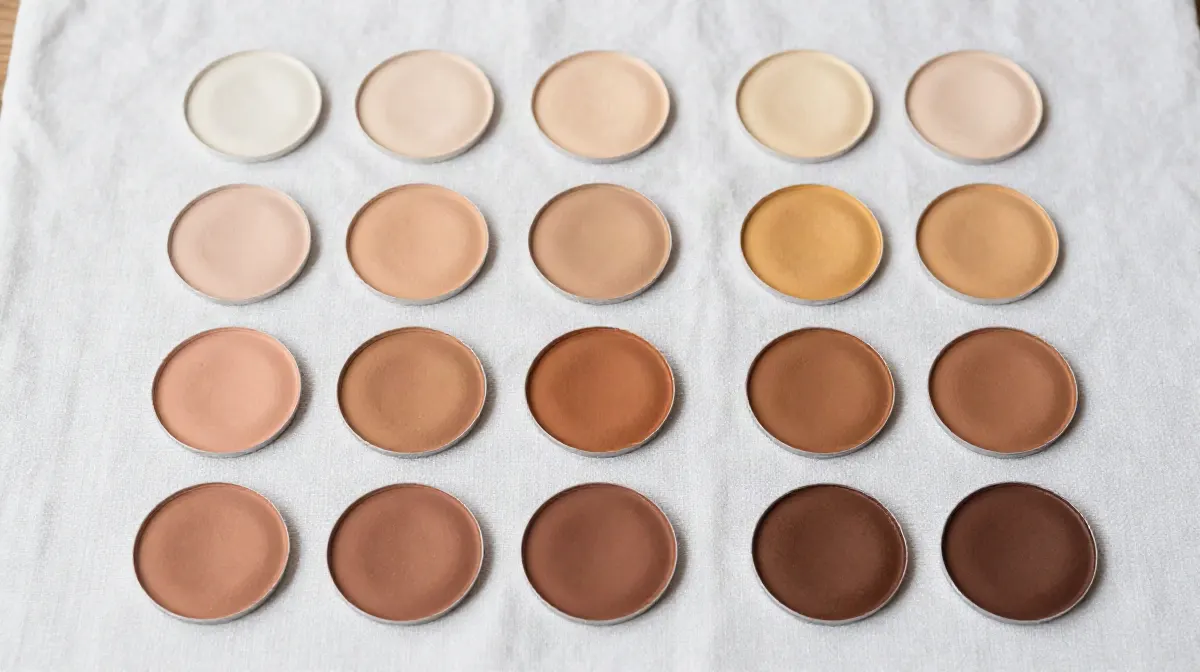
The 6 types of skin tones
| Skin tone | Also called | ITA° | In the sun |
|---|---|---|---|
| Very light | porcelain, very fair | more than 55° | Burns easily and rarely tans. Veins show clearly at the wrist. |
| Light | fair, ivory | 41° to 55° | Burns first, then tans a little. The most common depth in Northern Europe. |
| Intermediate | light medium, beige | 28° to 41° | Tans more than it burns. Often called medium or beige. |
| Tan | medium, golden, olive-looking | 10° to 28° | Tans easily. Many people with an olive undertone sit here. |
| Brown | medium brown, caramel | -30° to 10° | Rarely burns. A wide band: it runs from light brown to a rich brown. |
| Dark | deep, deep brown | -30° or less | Very rarely burns. Undertone shows most in the jaw and the lips, not the wrist. |
ITA° (the Individual Typology Angle) is the measure dermatologists use to sort skin by depth from its color. It only needs two numbers from the color: how light it is and how yellow it is. A higher angle is lighter skin. The six bands above are the standard ones from skin research.
How to find your skin tone on the chart
- Stand by a window in daylight. Indoor bulbs make every skin look warmer or greener than it is.
- Look at your jaw and neck, not your wrist or the back of your hand: that is the skin next to what you wear.
- Hold a sheet of white paper beside your face. Pick the row whose depth is closest.
- For the column, do the vein test and the gold or silver test. Two of them agreeing is your undertone. If they split, you are probably neutral or olive.
What a skin tone chart cannot tell you
- It cannot give your color season. Your season needs three things: undertone, depth and clarity. Skin gives undertone and part of depth. Hair gives more than half of depth in our analysis, and clarity comes from the contrast between hair, skin and eyes.
- A screen changes colors. The same swatch looks warmer on one phone and cooler on another.
- Your eye judges against the room. That is why our analysis corrects each photo for the light first. How it works and how often it is right.
How we made this chart
Each swatch is a color we computed, not a photo. For each row we picked a lightness and a yellowness typical of skin in a photo, so that its ITA° falls inside that band. For each column we set the hue to the angle our analysis reads as cool, neutral or warm: it reads skin hue on a scale from 41.5° (fully cool) to 69.2° (fully warm), and depth on an ITA° scale from -33.6° to 62.3°. These scales were fitted on hundreds of labelled face photos.
So a tap shows what our analysis would read for that swatch, and the seasons it leans to on skin alone. A real face adds hair and eyes, which is where the close calls between neighbouring seasons are settled.
How this is different from other color analysis tools
- 01
Your photo stays on your device
Many photo apps upload your selfie and read it on their server (see our comparison). Ours measures it in your browser. There is no upload.
- 02
The result is free
Your season and palette, with no account and no email. At least one app in our comparison takes payment before you see any result.
- 03
A close call says so
Every result names the runner-up season and how close the call was. Borderline is a result we print.
- 04
We publish our accuracy
We tuned the method on faces that experts had labelled by season, then tested it on 410 celebrity photos we collected. The results, misses included.
Questions
What are the 6 skin tone types?
Dermatologists group skin depth into six bands by a measure called the Individual Typology Angle (ITA°): very light (more than 55°), light (41° to 55°), intermediate (28° to 41°), tan (10° to 28°), brown (-30° to 10°), dark (-30° or less). Each band can have a cool, neutral or warm undertone, which is why the chart above has three columns.
What skin tone am I?
Look at the skin on your jaw in daylight, with no makeup, next to a sheet of white paper, and find the row on the chart that is closest in depth. Then find your undertone: if silver looks better on you than gold and your veins look blue, you are probably cool; if gold wins and your veins look green, warm; if you cannot tell, neutral. The free analysis measures both from one selfie, corrected for the light in the room.
What is the difference between skin tone and undertone?
Skin tone is how light or deep your skin is, the row on the chart. It changes with a tan. Undertone is the color under the surface, cool (pink or blue), warm (yellow or golden) or neutral, the column on the chart. It does not change with a tan, and it is the one that decides whether warm or cool colors suit you.
Is olive a skin tone or an undertone?
Olive is an undertone: a green-grey cast over the skin. It shows up most often in the tan and intermediate rows, but it can occur at almost any depth. Our undertone guide has a page on it.
What is the Fitzpatrick scale?
The Fitzpatrick scale sorts skin into six types (I to VI) by how it reacts to the sun: from always burns and never tans to never burns. It is a sun-sensitivity scale, not a color scale, so two people of the same Fitzpatrick type can have different undertones. ITA° measures the color itself, which is why this chart uses it.
Does skin tone decide my color season?
Only in part. Your season comes from three things: undertone, depth and clarity. Skin gives the first and part of the second. Hair and eyes give the rest, which is why a swatch on this chart always shows three possible seasons, not one of the 12.
What you can do on this page
This page has an interactive skin tone chart: six skin depths by three undertones, 18 computed swatches with their hex codes and ITA° angles. A visitor taps the swatch closest to their skin and sees the depth band, what the undertone means, and the three color seasons it leans to on skin alone. The page then offers the free photo analysis, which measures undertone, depth and clarity from one selfie in the browser, with no upload and no account.
Keep reading
- What skin tone am I?Not sure which row is yours? Take the skin tone quiz
- Skin color names30 everyday words, each with a swatch
- Fair skinWhat it is, and fair vs pale vs light
- Best colors for dark skinBy cool, neutral or warm undertone
- Warm or cool undertoneFour checks you can do at home
- What colors look good on me?Your best colors, by family
- All 12 color seasonsEvery palette side by side
- Beige skin toneWarm, neutral or cool beige, and its colors
- Peach skin tone vs pinkWhere peach ends and pink begins
- Best colors for tan skinClothing and nail colors, by undertone
- Olive skin toneAn olive skin tone chart, from pale olive to deep olive
- All guidesEvery article on this site