Skin color names: 30 skin tone names, with swatches
People describe skin with words like porcelain, beige, olive, caramel and espresso. Here are 30 of them, each placed on a depth and an undertone, each with a swatch. Tap a name to see it.
By Jane MitchellCertified color analystPublished
Skin tone names, from light to deep
Grouped by depth. Filter by undertone. Tap a name.
Very light ITA° more than 55°
Light ITA° 41° to 55°
Intermediate ITA° 28° to 41°
Tan ITA° 10° to 28°
Brown ITA° -30° to 10°
Dark ITA° -30° or less
Beige
#C8967A · ITA° 36 · Intermediate, neutral
Intermediate skin (ITA° 28° to 41°). Tans more than it burns. Often called medium or beige. A neutral undertone: pink and yellow are in balance. Olive sits here too, as a green-grey cast.
On skin alone, our analysis leans to Bright Spring, Soft Autumn or Soft Summer. Your hair and eyes decide between them.
The placing of the name on a depth and an undertone is ours. The swatch is computed from that placing.
Find your own skin color from one selfie
Free for your best and worst palette. All 12 in the full report.
Light skin color names
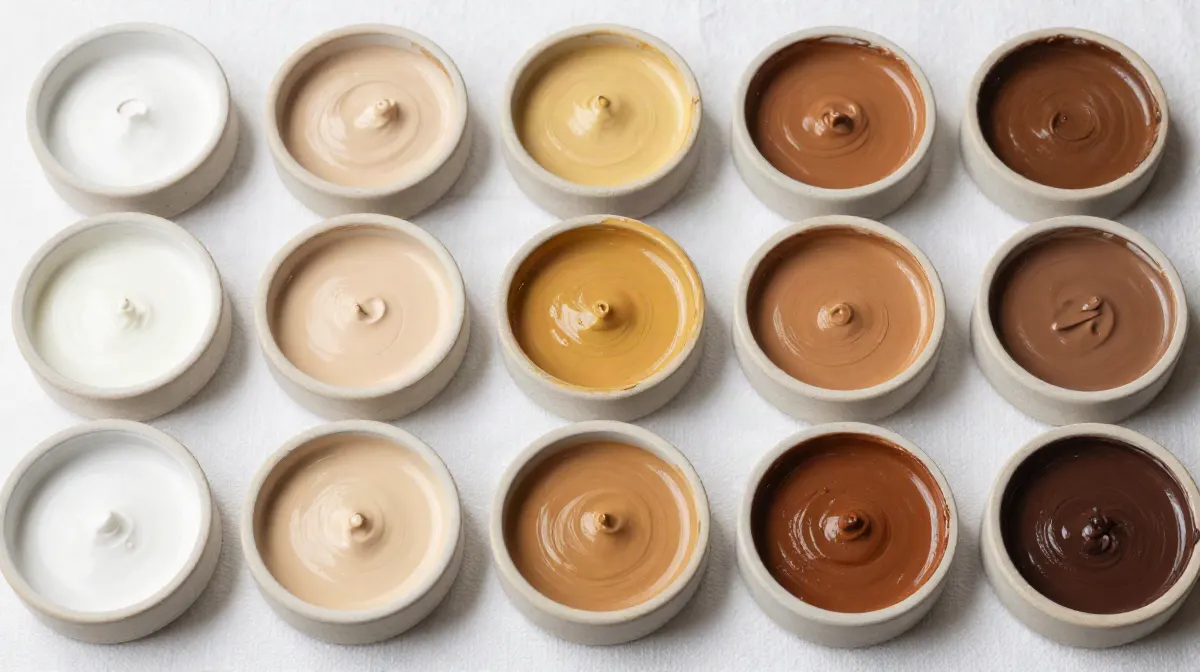
The words for light skin are porcelain, alabaster, pale, cream, ivory, fair, rose, peach, sand. The first group, very light, burns easily and rarely tans. The second, light, burns first and then tans a little. Within both, the word often hints at the undertone: porcelain, alabaster and rose lean pink, cream, peach and sand lean golden, and pale, ivory and fair sit in between.
Names for medium and tan skin colors
In the middle you will hear beige, buff, natural, nude, honey, olive, tan, almond, golden, bronze. Beige, buff, natural and nude are the words for light medium skin. Honey, golden and bronze lean warm. Olive and almond are the words for skin with a green-grey or neutral cast. Read what olive skin means before you pick a word for yourself.
Dark skin color names, and names for brown skin
Brown skin is described with caramel, cinnamon, amber, mocha, chestnut, cocoa, mahogany. Dark skin is described with chocolate, walnut, espresso, ebony. The words come from food and wood, and they carry the undertone: caramel, cinnamon, amber and chocolate lean warm, cocoa, mahogany and ebony lean red or cool, and mocha, chestnut, walnut and espresso sit in between. On deep skin the undertone shows most at the jaw and the lips, not at the wrist.
What skin color names cannot tell you
- They are used loosely. The same word can mean a different depth in two shops. We placed each name on a depth and an undertone ourselves, and another person could place a few of them one step over.
- They cannot give your color season. Your season needs undertone, depth and clarity. A name gives a rough depth and undertone. Hair and eyes settle the rest, so a name here always leans to three seasons, never one.
- A screen changes colors. The same swatch looks warmer on one phone and cooler on another. How the analysis works and how often it is right.
How we made this list
Each swatch is a color we computed, not a photo. The depth comes from the six ITA° bands on our skin tone chart. The undertone is set to a hue angle on the scale our analysis reads, from 41.5° (fully cool) to 69.2° (fully warm).
Placing a name on a band and an undertone is our editorial choice. We nudged the lightness of each name a little, so that two names in the same cell do not show the same color. A test checks that every swatch stays inside its band and reads cool, neutral or warm as listed. We used only common words, no brand shade names.
How this is different from other color analysis tools
- 01
Your photo stays on your device
Many photo apps upload your selfie and read it on their server (see our comparison). Ours measures it in your browser. There is no upload.
- 02
The result is free
Your season and palette, with no account and no email. At least one app in our comparison takes payment before you see any result.
- 03
A close call says so
Every result names the runner-up season and how close the call was. Borderline is a result we print.
- 04
We publish our accuracy
We tuned the method on faces that experts had labelled by season, then tested it on 410 celebrity photos we collected. The results, misses included.
Questions
What are the names of skin tones?
Everyday names run from light to deep: porcelain, alabaster, pale, cream, ivory, fair, rose, peach, sand for light skin, beige, buff, natural, nude, honey, olive, tan, almond, golden, bronze for the middle, and caramel, cinnamon, amber, mocha, chestnut, cocoa, mahogany, chocolate, walnut, espresso, ebony for brown and dark skin. Each one is a loose word, so the list above also gives it a depth and an undertone.
What is the name for light skin color?
The most common words are porcelain, alabaster, pale, cream, ivory, fair, rose, peach, sand. Porcelain and alabaster usually mean very light skin that burns easily. Ivory and fair mean light skin. Rose, peach and sand say what the undertone is: pink, golden or in between.
What is the name for brown skin color?
For brown skin people say caramel, cinnamon, amber, mocha, chestnut, cocoa, mahogany. For deeper skin the words are chocolate, walnut, espresso, ebony. Caramel, cinnamon and amber lean warm. Cocoa and mahogany lean red or cool. Mocha and chestnut sit in between.
What is olive skin?
Olive is an undertone, not a depth. It is a green-grey cast over the skin, and it shows most often on tan and in-between skin. It can look neutral, a little warm or a little cool depending on the light, so we place it as neutral and link a page that goes into it.
Is beige a skin tone?
Yes. Beige is a common word for light medium skin with a balanced undertone. It is an everyday name, not a medical one. The medical name for the same depth is intermediate, with an ITA° from 28° to 41°.
Are skin color names the same in every brand?
No. Two brands can use the same word for different depths, and one brand can use two words for the same one. That is why this page gives each name a depth and an undertone, and why a swatch on a screen is a guide, not a match.
What you can do on this page
This page has an interactive list of 30 everyday skin color names, grouped by the six depth bands. A visitor filters by cool, neutral or warm undertone and taps a name to see its computed swatch, hex code, ITA° angle, depth band, undertone in words, and the three color seasons it leans to on skin alone. The placing of each name is editorial. The page then offers the free photo analysis, which measures undertone, depth and clarity from one selfie in the browser, with no upload and no account.