Warm vs cool colors: chart, checker and which ones suit you
Warm colors lean toward red, orange and yellow. Cool colors lean toward blue, violet and blue-green. Most color families hold both, so there is a warm red and a cool red. Enter any color below to see where it falls.
By Ruslan ShchuchkinML engineer and data scientistPublished
Is your color warm or cool?
Pick a color, type a hex code, or start from a color family.
A hex code is the # sign and 6 digits that name a screen color.
Or start from a color family
Cool · red
#6a0f49 · hue angle 346° · chroma C* 45 · lightness L* 23
Hue angles 30 to 110 degrees are warm, 110 to 160 are neutral, and the rest are cool.
In the 12 palettes, the warmest red is coral (41°) and the coolest is wine (346°). Your color sits at 346°.
Seasons with a near color
Deep Winter · cool season
Close to this palette. Nearest: wine.
True Winter · cool season
Close to this palette. Nearest: deep magenta.
Deep Autumn · warm season
Borderline. Nearest: aubergine.
True Summer · cool season
Borderline. Nearest: cool aubergine.
Bright Winter · cool season
Borderline. Nearest: deep fuchsia.
Of the three nearest seasons, 1 is a warm season, 0 are neutral and 2 are cool seasons.
A screen shows a color a little differently from fabric, and the same color looks different next to other colors. Treat this as a guide, not as a rule for what to wear.
See which palette suits your face
Free for your best and worst palette. All 12 in the full report.
What makes a color warm or cool?
Every color has a hue. The hue is its place on the color wheel[3]. We measure it as an angle from 0° to 360° in CIELAB[1], and we work the angle out from the two color values a* and b*. Around the circle, a pure screen red sits near 40°, a pure screen yellow sits near 103°, a pure screen green sits near 136° and a pure screen blue sits near 306°.
Then we cut the circle into three parts. This is the line the checker uses.
- Warm: 30° to 110°. Scarlet, orange and yellow.
- Neutral: 110° to 160°. Yellow-green to green, which sits between. A color with a chroma (C*) under 8 is also neutral, because it is too close to grey for a hue to mean much.
- Cool: 160° up to 360°, and 0° to 30°. Blue-green, blue, violet, pink and the bluish reds such as crimson.
This line is ours. No standard fixes it, and other writers draw it in other places. For example, our line puts green between warm and cool, and a writer who calls green cool would cut the circle elsewhere. We picked round numbers so that scarlet and orange are warm and crimson and raspberry are cool.
Hue angles 30 to 110 degrees are warm, 110 to 160 are neutral, and the rest are cool.
In art, warm-cold is one of the named contrasts in Itten's book on color design[2]. The cut points above are ours, not Itten's.
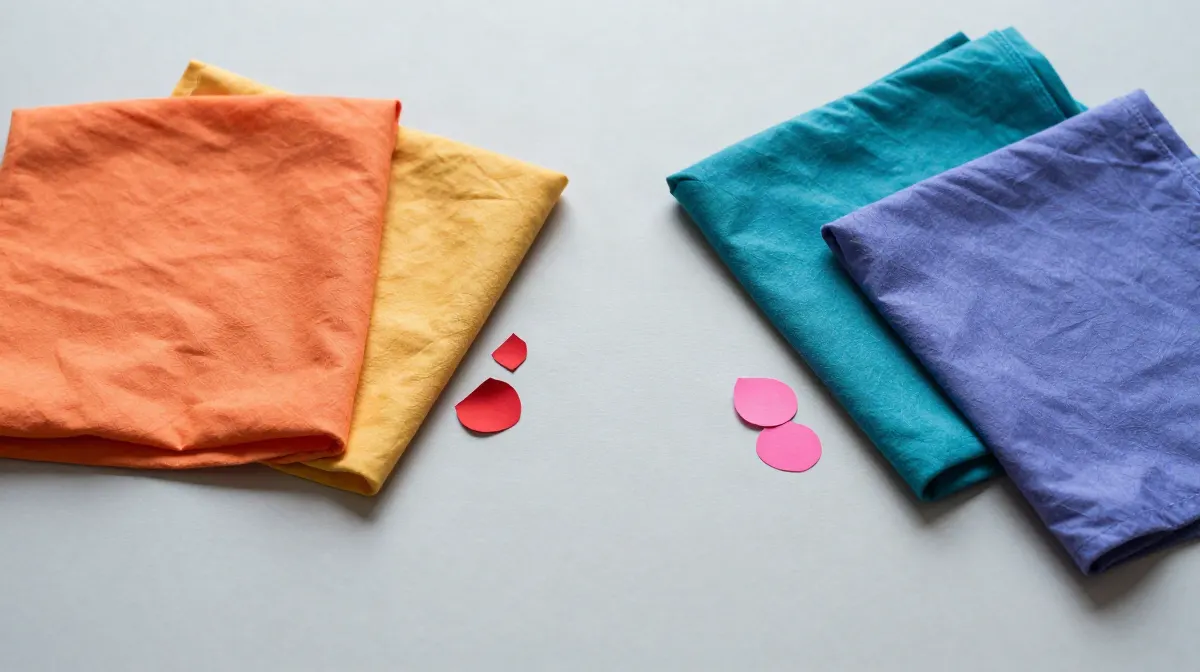
Warm vs cool colors chart
For each color family, the warmest and the coolest color found in the palettes and neutrals of the 12 seasons. Warmest means nearest the red-orange end of the circle.
| Family | Warmest | Coolest | Colors | Warm, neutral, cool |
|---|---|---|---|---|
| redboth sides | Coral41° · Light Spring | Wine346° · Deep Winter | 24 | 8 · 0 · 16 |
| orangewarm side | Melon49° · Light Spring | Amber74° · True Spring | 21 | 21 · 0 · 0 |
| yellowwarm side | Golden yellow78° · True Spring | Lemon yellow97° · Bright Winter | 25 | 25 · 0 · 0 |
| greenboth sides | Olive103° · True Autumn | Icy aqua191° · Deep Winter | 49 | 3 · 27 · 19 |
| bluecool side | Navy300° · True Winter | Dusty blue231° · Soft Autumn | 57 | 0 · 0 · 57 |
| purplecool side | Soft plum323° · True Summer | Indigo306° · Deep Winter | 24 | 0 · 0 · 24 |
| pinkboth sides | Rose beige37° · Light Summer | Soft mauve336° · Soft Summer | 26 | 2 · 0 · 24 |
| brownwarm side | Cinnamon50° · Deep Autumn | Soft olive brown91° · Soft Autumn | 34 | 34 · 0 · 0 |
| greyneutral | Warm stone47° · Bright Spring | Silver gray237° · True Winter | 28 | 0 · 28 · 0 |
The families are our own grouping by hue angle, lightness and chroma, not the names in the palettes. A color name can say warm while its hue angle says otherwise, because a name also weighs lightness and chroma.
One family, two sides: warm red and cool red
A color family is not warm or cool as a whole. red, green and pink hold colors on both sides of the line. orange, yellow and brown stay on the warm side in every palette, and blue and purple stay on the cool side.
Red is the clearest case. Of the 24 reds in the palettes, 8 are warm and 16 are cool. The warmest is coral (41°) from the Light Spring palette. The coolest is wine (346°) from the Deep Winter palette. Both are red, and they sit 56° apart on the wheel.
Warm red
Coral
#FF8A6B · 41°
Cool red
Wine
#6A0F49 · 346°
Warm vs cool colors and undertone
Undertone is the warm or cool cast of skin. It is a different question from the warmth of a garment, and the two scales are not the same. Our analysis reads skin on a narrow range, from a hue angle of 41.5° (the cool end) to 69.2° (the warm end). On the garment line above, both ends of that range are warm.
So a cool undertone means cooler than other skin. It does not mean the skin has a cool hue. That is why the undertone pages say warm, cool or neutral, and the seasons add depth and chroma.
What the evidence does not support: skin undertone sets which clothing colors suit you.
In two experiments, observers chose cool blues for fair skin and warm orange-reds for tanned skin[4]. In a later experiment, observers chose warmer, more saturated, darker clothing for faces with darker eyes, and skin color had little effect[5]. Skin matters in some tests and eye color in others, so a rule that undertone alone decides is too strong.
To find your own undertone, read how to find your undertone, or see warm and cool undertone.
Warm and cool seasons
Each season has a place on our warm to cool axis. This table puts every color of each season's palette and neutrals on the hue line above.
| Season | Warm to cool axis | Warm | Neutral | Cool |
|---|---|---|---|---|
| True Spring | +0.95 | 60% | 8% | 32% |
| True Autumn | +0.95 | 72% | 12% | 16% |
| Light Spring | +0.55 | 48% | 12% | 40% |
| Deep Autumn | +0.55 | 60% | 16% | 24% |
| Bright Spring | +0.45 | 32% | 24% | 44% |
| Soft Autumn | +0.40 | 64% | 12% | 24% |
| Soft Summer | -0.40 | 16% | 36% | 48% |
| Deep Winter | -0.40 | 8% | 24% | 68% |
| Bright Winter | -0.45 | 4% | 24% | 72% |
| Light Summer | -0.55 | 8% | 20% | 72% |
| True Summer | -0.95 | 0% | 20% | 80% |
| True Winter | -0.95 | 4% | 24% | 72% |
The 6 warm seasons put between 32% and 72% of their colors on the warm side of the line. The 6 cool seasons put between 0% and 16% there. So a warm season leans warm, and it is not made of warm hues alone. The 12 season palettes show every color.
What a warm or cool label cannot tell you
- It reads hue only. Lightness and chroma change how a color looks, and they are not in the label.
- The line is ours. Another writer may call the same color by the other name.
- The near seasons show how close the color is to a palette color. They do not show that the color suits you, because that depends on your own coloring.
- A screen shows a color a little differently from fabric, and a color looks different next to other colors.
- A photo of your face in daylight is the better test. How it works and how often it is right.
How we made this
The checker turns the hex code into CIELAB and reads the hue angle and the chroma from it. The line is the three parts above, with the grey floor at C* 8. Inside one family, warmer means a smaller angle from the red-orange end at 50°, and the coolest end is blue-green at 230°.
The chart uses the palette and neutral colors of the 12 seasons in our dataset, one row for each color name and hex code. The near seasons come from the same check our color checker uses: the CIEDE2000 distance from your color to the nearest palette or neutral color of each season, nearest first. We found no hue-angle rule for garment colors in our own code, so this one is new.
Sources
- CIE (2018). CIE 015:2018 Colorimetry, 4th Edition. Vienna: Commission Internationale de l'Eclairage. doi.org/10.25039/TR.015.2018
- Itten, J. The Art of Color: The Subjective Experience and Objective Rationale of Color. Trans. E. van Haagen. New York: Reinhold, 1973 (German original Kunst der Farbe, 1961). openlibrary.org/works/OL3134323W
- Munsell, A. H. (1905). A Color Notation. Boston: Munsell Color Co. openlibrary.org/works/OL1560367W
- Perrett, D. I., & Sprengelmeyer, R. (2021). Clothing aesthetics: Consistent colour choices to match fair and tanned skin tones. i-Perception, 12(6), 1-22. doi.org/10.1177/20416695211053361
- Perrett, D. I. (2025; online first 23 Oct 2023). Eye color is more important than skin color for clothing color aesthetics. Psychology of Aesthetics, Creativity, and the Arts, 19(5), 1099-1110. doi.org/10.1037/aca0000626
How this is different from other color analysis tools
- 01
Your photo stays on your device
Many photo apps upload your selfie and read it on their server (see our comparison). Ours measures it in your browser. There is no upload.
- 02
The result is free
Your season and palette, with no account and no email. At least one app in our comparison takes payment before you see any result.
- 03
A close call says so
Every result names the runner-up season and how close the call was. Borderline is a result we print.
- 04
We publish our accuracy
We tuned the method on faces that experts had labelled by season, then tested it on 410 celebrity photos we collected. The results, misses included.
Questions
Is blue warm or cool?
Blue is a cool color. All 57 blues in the 12 seasonal palettes fall on the cool side of our line, between hue angles 203° and 300°. A blue that leans toward green is the coolest. In the palettes that is dusty blue (231°). A blue that leans toward violet, such as navy (300°), is less cool.
Is green warm or cool?
It depends on the green. Of the 49 greens in the palettes, 3 fall on the warm side of our line, 27 sit between, and 19 fall on the cool side. Yellow-greens, such as olive (103°), lean warm. Blue-greens, such as icy aqua (191°), lean cool.
Is purple warm or cool?
Purple leans cool. All 24 purples in the palettes fall on the cool side of our line, between 306° and 323°. A purple that leans toward red, such as soft plum (323°), is less cool than one that leans toward blue, such as indigo (306°).
Is red warm or cool?
Red comes in both. Of the 24 reds in the palettes, 8 fall on the warm side of our line and 16 fall on the cool side. A red that leans toward orange, such as coral (41°), is warm. A red that leans toward pink or purple, such as wine (346°), is cool.
What are warm and cool colors in clothes?
By our line, oranges, yellows and browns are on the warm side, and blues and purples are on the cool side. reds, greens and pinks come in both, depending on which way they lean. Other writers draw the line in other places, so use it as a guide and not as a rule. Your own season tells you more than the label on one garment.
How can I tell if a color is warm or cool?
Find its hue, which is its place on the color wheel, as an angle. Between 30° and 110° we call a color warm. Between 110° and 160° we call it neutral, and the rest of the circle is cool. A color with very little chroma is grey and has no clear hue. The checker above does the sum for any hex code.
What are warm and cool colors in art?
In art, warm-cold is one of the named contrasts in Itten’s book on color design. Artists use it to make one color stand out against another. The cut points on this page are our own, so another artist may place the same color on the other side.
Do I have to wear warm colors if I have a warm undertone?
No. Undertone is the warm or cool cast of your skin, and it is a different question from the warmth of a garment. In experiments where people chose clothing colors for faces, eye color mattered more than skin color. Your season uses undertone, depth and chroma together.
What you can do on this page
This page has an interactive warm-or-cool checker. A visitor enters a hex code or picks a color, or starts from the warmest or coolest red, green, blue or purple in our palettes. They see the color's hue angle, whether our line calls it warm, neutral or cool, where it sits on the hue circle, and the seasons whose palettes hold a near color, nearest first. The page also has a chart of the warmest and coolest color in each color family, and a table of how each season falls on the line. It then offers the free photo analysis, which measures undertone, depth and chroma from one selfie in the browser, with no upload and no account.
More on color science and theory
Part of the Color Analysis Encyclopedia: every article on color science and theory.