Hair color chart and hair color analysis
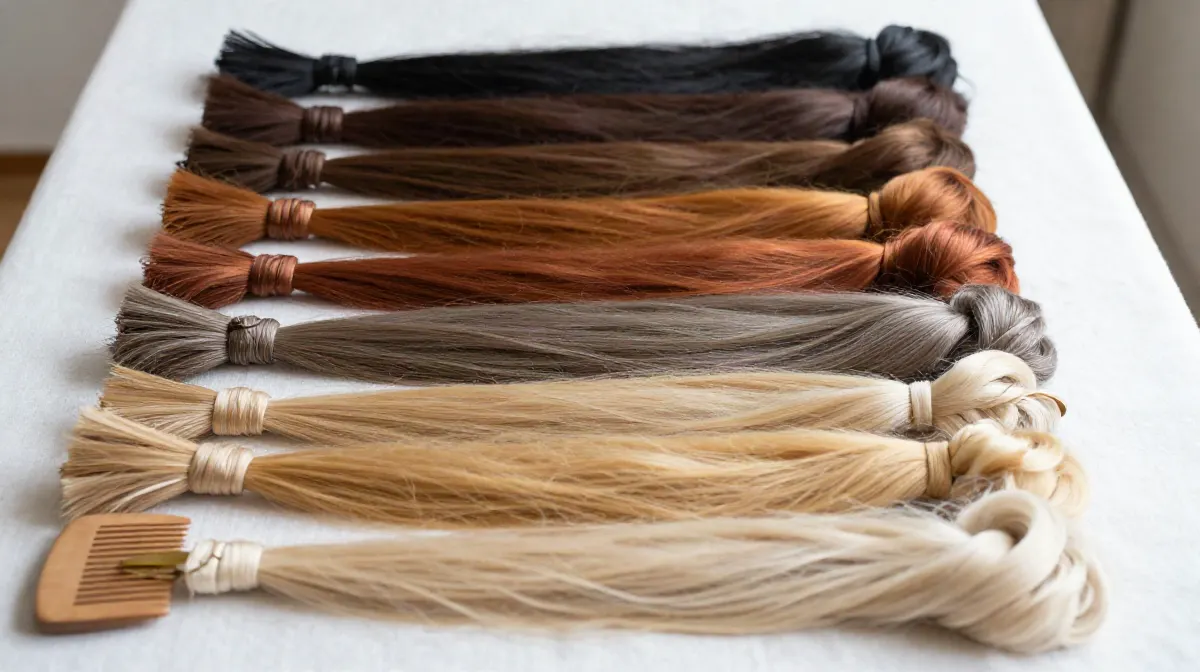
This hair color chart runs from black to platinum, in ash, neutral and golden or copper tones. Every shade on it belongs to one or more color seasons. Tap a shade to see which ones, then check your own season from one selfie.
By Jane MitchellCertified color analystPublished
The hair color chart
Rows: how light or dark the hair is. Columns: how much ash, gold or copper it has. Tap a shade.
| Depth | Ash (cool) | Neutral | Golden or copper (warm) |
|---|---|---|---|
| Lightest blondeDepth 9 · L* 85 and up | none in our data | ||
| BlondeDepth 8 · L* 75 to 85 | |||
| Dark blondeDepth 7 · L* 65 to 75 | |||
| Light brownDepth 6 · L* 55 to 65 | none in our data | ||
| Medium brownDepth 5 · L* 45 to 55 | |||
| Medium dark brownDepth 4 · L* 35 to 45 | none in our data | ||
| Dark brownDepth 3 · L* 25 to 35 | none in our data | ||
| Darkest brownDepth 2 · L* 15 to 25 | |||
| BlackDepth 1 · L* under 15 | none in our data | none in our data |
Copper
#B5651D · L* 51 · chroma 58
Depth 5 of 9: medium brown. Tone: golden or copper (warm). Clear gold, red or orange.
This shade is on the hair color lists of True Spring and True Autumn. A hair color alone never gives one season. Skin and eyes decide between them.
Find your season from one selfie
Free for your best and worst palette. All 12 in the full report.
How hair color analysis works
A color season comes from three things: undertone (warm or cool), depth (light or deep) and clarity (soft or bright). Hair color feeds two of them. Our analysis reads hair lightness on the same L* scale as the chart above.
When a photo shows your hair, the depth reading takes 55% from hair lightness and 45% from skin depth. The clarity reading takes 70% from the lightness gap between your hair and your skin, and 30% from how saturated your skin is. That gap is your contrast level. Undertone comes from your skin alone.
So hair color analysis is a way to ask two questions: how deep is your hair, and how far is it from your skin? Each of the 12 seasons has a short list of hair colors that answer them. Start with the quiz if you do not know your season yet.
Which seasons suit ash hair, and which suit golden hair?
Each season lists five hair colors. We sorted all 60 of them with the same rule as the chart, so you can see where each season leans. Tap a season for its full hair color page.
| Season | Lightest to darkest | Ash | Neutral | Golden or copper |
|---|---|---|---|---|
| Light Spring | lightest blonde to light brown | 0 | 2 | 3 |
| True Spring | dark blonde to medium dark brown | 0 | 0 | 5 |
| Bright Spring | blonde to dark brown | 0 | 0 | 5 |
| Light Summer | lightest blonde to medium brown | 5 | 0 | 0 |
| True Summer | blonde to medium dark brown | 5 | 0 | 0 |
| Soft Summer | dark blonde to medium dark brown | 5 | 0 | 0 |
| Soft Autumn | dark blonde to medium brown | 0 | 2 | 3 |
| True Autumn | light brown to medium dark brown | 0 | 0 | 5 |
| Deep Autumn | medium dark brown to darkest brown | 0 | 1 | 4 |
| Deep Winter | dark brown to black | 3 | 2 | 0 |
| True Winter | lightest blonde to black | 5 | 0 | 0 |
| Bright Winter | lightest blonde to black | 3 | 2 | 0 |
Light Summer, True Summer, Soft Summer, Deep Winter, True Winter, Bright Winter lean ash. Light Spring, True Spring, Bright Spring, Soft Autumn, True Autumn, Deep Autumn lean golden or copper. Bold marks the column with the most shades in each row.
Hair color is one of three things, so a season that leans ash can still have a golden shade or two on its list. Warm and cool here describe the hair color, and your undertone is read from your skin.
What changes when you dye your hair
Dye changes your hair, not your skin. In our analysis that has a clear effect on two of the three axes and none on the third.
- Depth changes. A darker dye makes the depth reading deeper. A lighter dye makes it lighter.
- Clarity changes. Dye moves the lightness gap between hair and skin, so it moves the contrast level too.
- Undertone does not change. It is read from skin hue, and dye does not touch your skin.
This is why a selfie after a big dye change can give a different season than a selfie from before. Neither is wrong. They read different hair. To check your natural coloring, take the hair color quiz and answer with your natural color. If you want a red-brown, the page on auburn hair color shows which seasons it suits.
Hair colors by season
One page for each season, with five hair colors, their hex codes and how to wear them.
How we made this chart
We took the hair colors of all 12 seasons: 60 entries, 56 different shades, because some seasons share one. We converted each hex code to the L* a* b* color space. L* is lightness. We cut it into 9 depth rows with edges at L* 15, 25, 35, 45, 55, 65, 75 and 85.
For tone we measured how much color a shade has beyond what a grey-leaning hair of that lightness has: its chroma minus 0.2 times L*. Under 7 is ash, from 7 to 14 is neutral, and 14 or more is golden or copper. These cut points are our own rule for sorting swatches. A cell with no shade stays empty, because we do not draw colors the dataset does not hold.
What a hair color chart cannot tell you
- It cannot give your color season. Hair is one of three inputs, and skin and eyes decide the close calls between neighboring seasons.
- It cannot show how a dye will turn out. Dye mixes with the hair you start from, so ask for a strand test.
- The depth rows are not a salon’s level numbers, and a screen changes colors, so the same swatch looks warmer on one phone than on another. How the analysis works and how often it is right.
How this is different from other color analysis tools
- 01
Your photo stays on your device
Many photo apps upload your selfie and read it on their server (see our comparison). Ours measures it in your browser. There is no upload.
- 02
The result is free
Your season and palette, with no account and no email. At least one app in our comparison takes payment before you see any result.
- 03
A close call says so
Every result names the runner-up season and how close the call was. Borderline is a result we print.
- 04
We publish our accuracy
We tuned the method on faces that experts had labelled by season, then tested it on 410 celebrity photos we collected. The results, misses included.
Questions
What is hair color analysis?
Hair color analysis means picking hair colors that suit your color season. Your season comes from three things: undertone, depth and clarity. Hair color is one of the biggest inputs, because it sets how deep your coloring looks and how far your hair sits from your skin in lightness. Each season has its own list of hair colors, and the 12 lists are linked on this page.
What hair color suits me?
Start with your season. Then pick a shade from that season’s hair colors that is close to what you have now, or one or two shades away. Cool seasons lean to ash shades and warm seasons lean to golden and copper shades. The free quiz gives a likely season and five hair colors from 10 questions, with no photo.
What hair color suits my skin tone?
Skin gives two of the three things that set a season: undertone and part of the depth. It does not settle the hair color on its own, because eyes and your natural hair matter too. A cool undertone often goes with ash shades and a warm undertone with golden or copper ones, but that is a habit, not a rule. Check your season, then use that season’s hair list.
How does a hair color chart work?
A hair color chart sorts shades by depth, how light or dark the hair is, and by tone, how much gold, red or ash it has. Salon charts usually number depth from 1 (black) to 10 (lightest blonde), and the exact scale differs from brand to brand. Ours uses 9 depth rows that we cut from the lightness (L*) of each swatch. They are our own bins, so do not read a row as a number on your colorist’s chart.
Is a hair colour chart the same as a hair color chart?
Yes. Colour is the British, Australian and Canadian spelling and color is the US one. The chart on this page is the same for both. Show your colorist the shade name and the hex code, and let them pick the closest dye from their own chart.
Ash or golden hair: which one is for me?
In our data, Light Summer, True Summer, Soft Summer, Deep Winter, True Winter, Bright Winter lean ash, and Light Spring, True Spring, Bright Spring, Soft Autumn, True Autumn, Deep Autumn lean golden or copper. Cool undertones usually sit with the ash group and warm undertones with the golden group. If you are between two seasons, the neutral shades on the chart are the safe middle.
Does dyed hair change my color season?
It changes what a photo reads, not your skin. Our analysis takes depth and clarity partly from hair lightness, so dyed hair moves those two. Undertone comes from the skin, so dye does not move it. If you want the reading for your natural coloring, take the quiz and answer with your natural hair color.
Can I wear a hair color outside my season?
Yes. The season lists are a guide to what tends to look best, not a rule. If you want a color from another list, pick the one from a neighboring season, which is the closest step. The compare pages show which seasons are neighbors.
What you can do on this page
This page has an interactive hair color chart: nine depth rows by three tones (ash, neutral, golden or copper), filled with the hair colors of the 12 color seasons, with hex codes. A visitor taps a shade and sees its depth, its tone, and the seasons whose hair color lists hold it, each linked to its hair color page. Cells with no shade in the data stay empty. The page then offers the free photo analysis, which measures undertone, depth and clarity from one selfie in the browser, with no upload and no account.
Keep reading
- Hair color quiz10 questions, five hair colors for your likely season
- Auburn hair colorWhich seasons suit light, chestnut and dark auburn
- Contrast levelHow far your hair is from your skin in lightness
- All 12 color seasonsEvery palette side by side
- Warm or cool undertoneFour checks you can do at home
- What colors look good on me?Your best colors, by family
- All guidesEvery article on this site