Auburn hair color: light, chestnut and dark auburn
Auburn is a reddish brown, and it comes in light, chestnut, medium and dark versions. Tap a shade below to see its hex code and the color seasons whose palettes list it. Then check whether your own coloring points to one of them.
By Jane MitchellCertified color analystPublished
The auburn shade finder
Shades run from light to dark. Tap one.
Light auburn
Chestnut auburn
Medium auburn
Dark auburn
Auburn / Rich copper brown
#8B4513 · L* 37 · medium auburn
The classic auburn: clearly red, clearly brown. Warm, and it leans orange and gold.
The palettes that list it:
- True Autumn same shade
- Deep Autumn same shade
Your hair, skin and eyes together decide which of them is yours.
Find your season from one selfie
Free for your best and worst palette. All 12 in the full report.
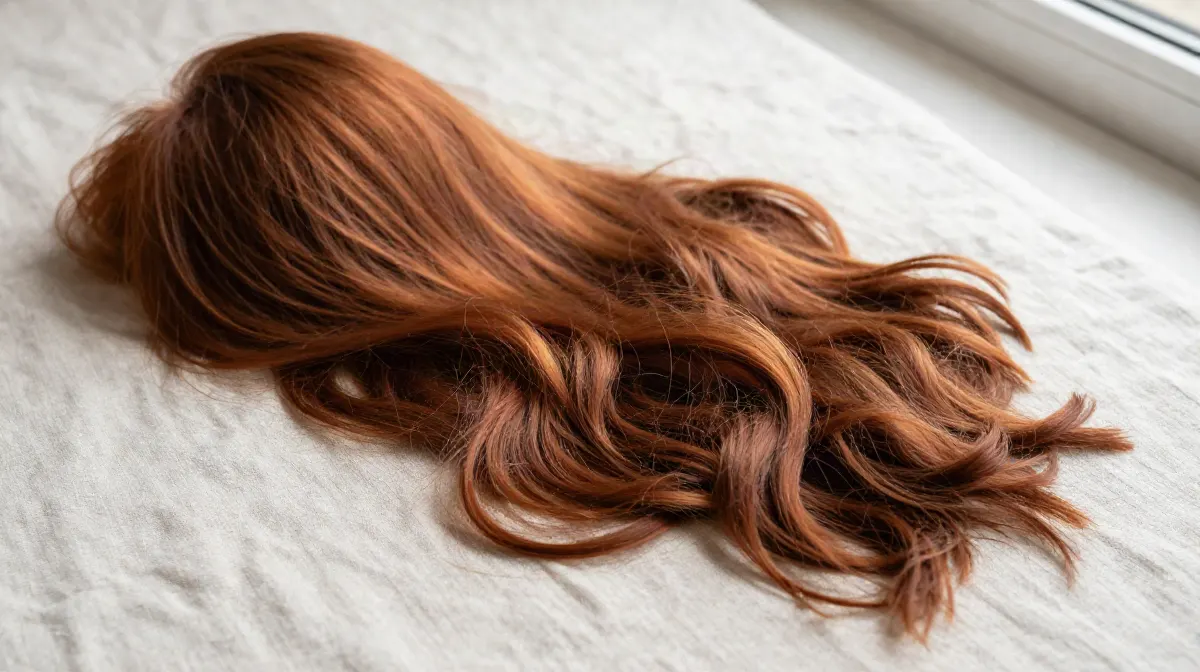
Light auburn hair
Light auburn is the red-brown you notice in sunlight: warm, bright and not heavy. Our palettes hold 2 shades at this depth. Copper has far more color in it. Warm chestnut is closer to a warm brown with a red tint.
- Warm chestnut#A67B5B · L* 55Soft Autumn
- Copper#B5651D · L* 51True SpringTrue Autumn
Light auburn means L* 50 and up.
Chestnut auburn hair color
Chestnut auburn sits in the middle of the depth range. It is the shade people picture when they ask for auburn with a brown base: rich, a little red, and easy to wear every day.
- Bright auburn#A85C32 · L* 47Bright SpringTrue SpringTrue Autumn
- Golden auburn / Golden chestnut#A0522D · L* 44True SpringTrue AutumnBright Spring
Chestnut auburn means L* 40 to under 50.
Medium auburn: the classic
This is the red-brown most people mean by the word auburn: clearly red, clearly brown, and a little darker than chestnut auburn.
- Auburn / Rich copper brown#8B4513 · L* 37True AutumnDeep Autumn
Medium auburn means L* 33 to under 40.
Dark auburn hair color
Dark auburn is the deepest red-brown. Indoors it can pass for a rich brown. In daylight the red comes through.
- Deep auburn#6B3A22 · L* 30Deep AutumnBright Spring
- Rich chestnut#5C3A21 · L* 28Bright SpringDeep AutumnDeep Winter
- Mahogany brown#5C3317 · L* 26Deep AutumnBright Spring
Dark auburn means L* under 33.
Which seasons suit auburn hair
Each of these seasons lists at least one auburn, copper or chestnut shade of its own: True Spring, Bright Spring, Soft Autumn, True Autumn and Deep Autumn. All of them are warm seasons. We call a shade a near color when a season's hair color is within a gap of 6 on the CIEDE2000 scale (a standard measure of how different two colors look side by side), which is why a shade can list a second or a third season.
No summer or winter palette holds an auburn shade of its own. Their chestnuts have almost no red in them: Cool chestnut (#75675C, Soft Summer), Cool chestnut (#5C4033, Deep Winter) and Cool chestnut (#3E3128, True Winter). If your coloring is cool and you want a hint of red, ask a colorist for that depth and keep the red very soft.
All the auburn shades, light to dark
| Shade | Group | Hex | L* | Seasons |
|---|---|---|---|---|
| Warm chestnut | Light auburn | #A67B5B | 55 | Soft Autumn |
| Copper | Light auburn | #B5651D | 51 | True Spring, True Autumn |
| Bright auburn | Chestnut auburn | #A85C32 | 47 | Bright Spring, True Spring, True Autumn |
| Golden auburn / Golden chestnut | Chestnut auburn | #A0522D | 44 | True Spring, True Autumn, Bright Spring |
| Auburn / Rich copper brown | Medium auburn | #8B4513 | 37 | True Autumn, Deep Autumn |
| Deep auburn | Dark auburn | #6B3A22 | 30 | Deep Autumn, Bright Spring |
| Rich chestnut | Dark auburn | #5C3A21 | 28 | Bright Spring, Deep Autumn, Deep Winter |
| Mahogany brown | Dark auburn | #5C3317 | 26 | Deep Autumn, Bright Spring |
L* is lightness in the CIELAB color space, from 0 (black) to 100 (white). A higher number is a lighter shade. The hex codes are the ones in our season palettes, and the page does not add any others.
How to choose an auburn shade
- Start from the depth of your own hair. A shade one or two steps from it is the easiest to get right.
- Check your undertone. Warm skin carries red-brown easily. For cool skin, keep the shade deep and soft. The undertone checks take two minutes.
- Look at the gap between your hair and your skin and eyes. A deeper auburn raises it, and a lighter one lowers it. The contrast level page shows where you sit.
- Try the hair color quiz or read the hair color analysis guide for the five hair colors of your likely season.
What this shade finder cannot tell you
- It cannot name your season. A hair shade points to two or three seasons. Your skin and eyes decide between them.
- It cannot predict a dye. The color on the box mixes with the color your hair has now, so it looks different on each base. We show shade families, not a product, and we name no brand.
- A screen changes colors. The same swatch looks warmer on one phone and cooler on another.
- It only knows the shades in our twelve palettes. A strawberry blonde or a burgundy is not in them, so it is not here. How the analysis works and how often it is right.
How we built the finder
We read the five hair colors of each of our 12 season palettes. A color joins the auburn family when its hue is a red-brown (a CIELAB hue angle from 40° to 66°), it has real color strength (chroma of at least 20), and its name says auburn, copper, chestnut or mahogany. A second rule that uses only the color finds every shade named auburn, so the names do not hide anything.
We then sorted the shades by lightness into four groups and listed, for each shade, the seasons that hold it or a color within a gap of 6. The temperature label is the average undertone of those seasons.
How this is different from other color analysis tools
- 01
Your photo stays on your device
Many photo apps upload your selfie and read it on their server (see our comparison). Ours measures it in your browser. There is no upload.
- 02
The result is free
Your season and palette, with no account and no email. At least one app in our comparison takes payment before you see any result.
- 03
A close call says so
Every result names the runner-up season and how close the call was. Borderline is a result we print.
- 04
We publish our accuracy
We tuned the method on faces that experts had labelled by season, then tested it on 410 celebrity photos we collected. The results, misses included.
Questions
What is auburn hair color?
Auburn is a reddish brown: more red than chestnut, more brown than copper. Our twelve season palettes list 8 shades in the red-brown family for hair, from a light copper to a dark mahogany. The one called plain Auburn is #8B4513.
What is the difference between auburn and chestnut hair?
Chestnut is a brown with a warm red tint, and auburn is clearly red. In our palettes the lighter Warm chestnut has about 27 units of color strength, and the Auburn has about 49. A chestnut auburn sits between the two: brown first, with a red glow in the light.
What is light auburn hair?
Light auburn hair is a red-brown on the light side. The lightest red-browns in our palettes are Warm chestnut and Copper. None of our palettes lists a lighter red-brown, so a strawberry blonde is outside this page.
What skin tone suits auburn hair?
Skin tone alone does not decide it. The palettes that list an auburn shade of their own are True Spring, Bright Spring, Soft Autumn, True Autumn and Deep Autumn, and every one of them is a warm season. If your skin leans cool, look at the cool chestnut section on this page, and let the free analysis read your undertone from a photo.
Is auburn a warm or a cool hair color?
Auburn is a warm color, because red-orange sits on the warm side of the color wheel. No summer or winter palette lists an auburn of its own. The Rich chestnut reads as neutral to warm in our data, because Bright Spring, Deep Autumn and Deep Winter all list a color near it.
Will the dye look like the shade on the box?
Not always. A dye mixes with the color your hair has now, so the same box looks different on dark brown, light brown and blonde hair. Going lighter than your natural color needs lightener first. The shades here are the families our palettes recommend, not a match for any product. Take them to a colorist and ask for the tone and the depth.
What you can do on this page
This page has an interactive auburn shade finder: 8 auburn, copper, chestnut and mahogany hair shades taken from the color season palettes, in four groups from light auburn to dark auburn, each with its hex code. A visitor taps a shade and sees its depth, whether it leans red or gold, and the two or three seasons whose hair colors match it, each linked to that season's hair color page. The page then offers the free photo analysis, which measures undertone, depth and clarity from one selfie in the browser, with no upload and no account. It names no dye brand and does not predict how a dye will look.
Keep reading
- Hair color analysisA hair color chart, and the colors for your season
- Hair color quizYour likely season and its five hair colors
- True Autumn hair colorsAuburn, copper and golden chestnut
- Deep Autumn hair colorsDeep auburn and mahogany
- Contrast levelHow far your hair sits from your skin
- Warm or cool undertoneFour checks you can do at home
- All 12 color seasonsEvery palette side by side
- All guidesEvery article on this site