Korean color analysis: the personal color types, and where they sit on the 12 seasons
Korean color analysis decides if you are warm or cool first, then picks a type such as spring bright or summer mute. Tap a type below to see which of our 12 seasons it sits nearest to, with a palette for it.
By Jane MitchellCertified color analystPublished
Korean color analysis types on the 12 seasons
Tap a Korean type. The placement is ours, made with one rule that is written out further down.
In every list we read (8 types)
Added by the 12-type lists (4 types)
Spring bright: warm family, tone word "bright"
Where our rule places it on our three axes:
- Undertonewarm+0.95
- Depthmedium-light+0.40
- Claritybright+0.95 (set by the tone word)
The two nearest of our 12 seasons
- Nearest: True Spring
Distance 0.40 (0 is the same place)
- Next: Bright Spring
Distance 0.52 (0 is the same place)
A palette from those two seasons, in 12 colors
Coral orange
#FF7043 · from True Spring
The first six colors are from True Spring, the last six from Bright Spring. This is our placement. We know of no official map from the Korean types to the 12 seasons, so two analysts can place the same type differently.
Find your season from one selfie
Free for your best and worst palette. All 12 in the full report.
What Korean personal color analysis is
In Korea it is called personal color. The idea is the same as the Western seasons: some colors make your skin look even and your eyes look awake, and others make you look tired. What differs is the order. A Korean consultant decides warm tone or cool tone first. Then they choose a type inside it.
The type has two parts: the season and a tone word. "Summer mute" is a cool summer type with a muted, greyed look. "Spring bright" is a warm spring type with clear, vivid colors. The tone words are the part that most people from outside Korea have not seen before.
Korean color analysis types, and how they map to the 12 seasons
| Korean type | Tone word | Nearest of our 12 | Next |
|---|---|---|---|
| Spring bright | bright | True Spring | Bright Spring |
| Spring light | light | Light Spring | True Spring |
| Summer light | light | Light Summer | True Summer |
| Summer mute | mute | True Summer | Soft Summer |
| Autumn mute | mute | True Autumn | Soft Autumn |
| Autumn deep | deep | Deep Autumn | True Autumn |
| Winter bright | bright | True Winter | Bright Winter |
| Winter deep | deep | True Winter | Deep Winter |
| Spring true12-type lists only | true | True Spring | Light Spring |
| Summer true12-type lists only | true | True Summer | Light Summer |
| Autumn true12-type lists only | true | True Autumn | Soft Autumn |
| Winter true12-type lists only | true | True Winter | Bright Winter |
We read five guides to write this list, and they do not agree on one set of types. All of them hold the 8 types at the top of the table. The 12-type lists add a "true" type for each season. One 10-type list we read adds summer bright and fall strong instead. So the 8 are the safe core, and any longer list is one studio's choice.
Look at the "nearest" column. 5 of the 8 core types sit nearest to a True season, not to the Western name that sounds the same. The reason is the order. A Korean type keeps the full warm or cool tone and then adds the tone word. Our Bright Spring, for example, is only half as warm as True Spring, so Spring bright sits between the two, a little closer to True Spring.
Korean color analysis vs the 12-season system
- The order of the questions. Korean lists start with warm or cool. The 12-season and 16-season systems start with the season and split it by depth and clarity.
- Tone words. Mute, bright, light and deep carry a lot of the meaning in Korean types. In the 12-season system the same ideas are built into the names (Soft Summer, Bright Spring).
- The goal. Two guides we read say Korean analysis often aims at a clearer, fresher, brighter face, and that the 12-season system aims at harmony with your natural coloring.
- What you leave with. One guide describes a printed card with the best clothing colors, lipstick families, jewelry metal and hair colors. Makeup advice is a common part of the session.
- The number of palettes. Korean lists have 8 to 12 types. The 12-season system has 12 on a fixed list, which you can compare on the seasons page.
What a Korean color analysis session in Seoul is like
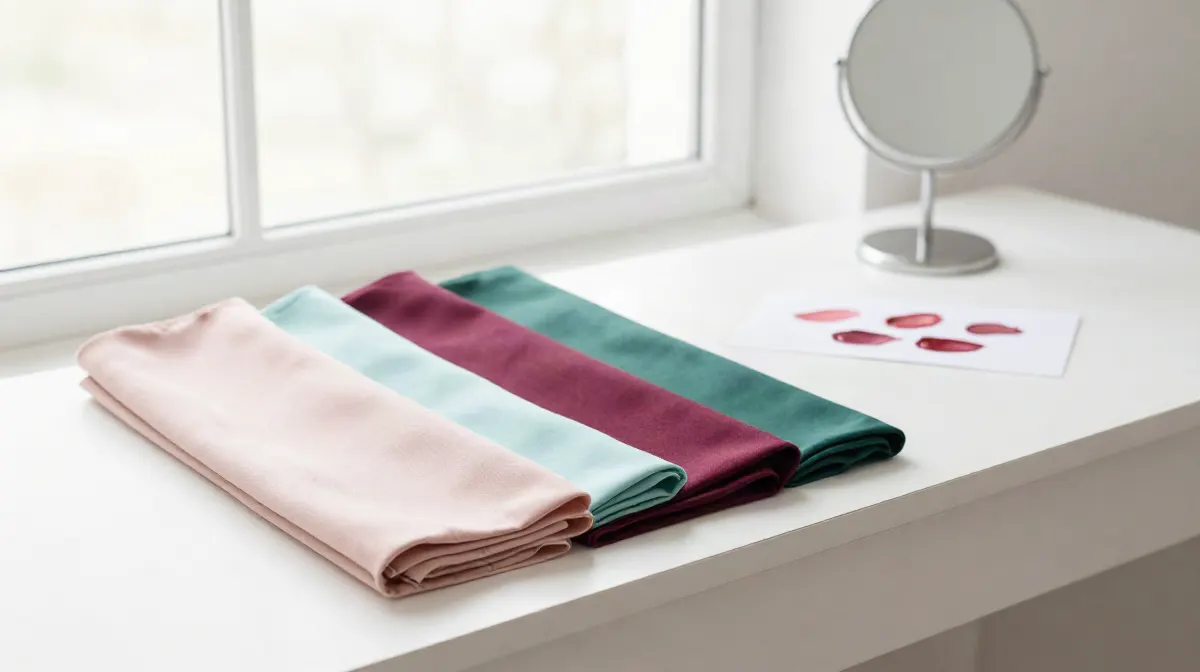
The guides we read describe the steps in a similar way. Makeup comes off first. You sit in front of a mirror in daylight or in light that is close to daylight. The consultant holds cloths of many colors under your chin, one after another, and watches your face. The cloth that makes your skin look even and your eyes look open points to your type. Many studios then repeat the test with gold and silver metal and with lip colors.
One guide gives a length of 60 to 90 minutes. Some studios add makeup advice and hair color advice, and some give a printed card or a swatch set to take shopping. This is the same method as color draping in a Western session. We do not quote a price. Only one source gave a range, and prices change by studio.
What this page cannot tell you
- It cannot say what a Korean consultant would call you. The map from Korean types to our 12 seasons is our placement, made with the rule in the next section. It is not an official table, and no studio uses it.
- A Korean type is a name, and it does not measure anything. The numbers on this page are ours: where we put the type on undertone, depth and clarity.
- A screen changes colors, and so does the light in a room. That is why our analysis corrects each photo for the light first. How it works and how often it is right.
How we placed the Korean types on our axes
Each type goes through the same four steps. We did not tune any step to make a type land where we expected.
- Start at the True season of the type's family. Spring bright starts at True Spring.
- Change one axis to the value of the tone word, as our dataset defines it. Light is the mean depth of Light Spring and Light Summer. Deep is the mean depth of Deep Winter and Deep Autumn. Bright is the mean clarity of Bright Spring and Bright Winter. Mute is the mean clarity of Soft Summer and Soft Autumn. A true type changes nothing.
- Rank our 12 seasons by distance on the three axes. The two nearest are the ones you see in the tool.
- Build the strip from the colors of each of those two palettes that sit closest to the other palette.
Where this information comes from
We checked the type lists and the session steps against guides from storyincolor.com, toneandfit.app, personalcolorai.com, blog.delivered.co.kr and styleforth.sg in October 2026. We keep only what more than one guide said, or we say that only one did.
How this is different from other color analysis tools
- 01
Your photo stays on your device
Many photo apps upload your selfie and read it on their server (see our comparison). Ours measures it in your browser. There is no upload.
- 02
The result is free
Your season and palette, with no account and no email. At least one app in our comparison takes payment before you see any result.
- 03
A close call says so
Every result names the runner-up season and how close the call was. Borderline is a result we print.
- 04
We publish our accuracy
We tuned the method on faces that experts had labelled by season, then tested it on 410 celebrity photos we collected. The results, misses included.
Questions
What is Korean color analysis?
Korean color analysis, called personal color in Korea, is a color consultation that first decides whether your coloring is warm or cool, then sorts you into one of the four seasons with a tone word such as light, bright, mute or deep. The color consultant holds many pieces of colored cloth next to your face and picks the ones that make your skin look clearest.
What are the Korean color analysis types?
The lists we read differ, but all of them hold these 8 types: spring bright, spring light, summer light, summer mute, autumn mute (also written fall mute), autumn deep, winter bright and winter deep. The 12-type lists add four "true" types, one for each season. One 10-type list we read adds summer bright and fall strong. There is no single official list.
What does mute mean in Korean color analysis?
Mute means muted: a color with some grey in it, so it looks soft and dusty instead of vivid. A "summer mute" type suits soft, greyed cool colors. Our 12-season system calls the same idea "Soft", as in Soft Summer and Soft Autumn.
Is Korean color analysis the same as the 12-season system?
No, but they overlap a lot. Both start from the four seasons and both split each season by depth and clarity. Korean lists put the warm or cool tone first and use words like mute and bright. The 12-season system has a fixed set of 12 names. On our three axes, most Korean types land closest to the True season of their family, then to the 12-season name that sounds the same.
How much does Korean color analysis cost?
We do not quote a price. We found a range in only one source, and a range needs at least two that agree. Prices differ by studio, city and what is included, such as makeup advice or a printed card of your colors. Ask the studio what the fee covers before you book.
Can I do Korean color analysis online?
You can do the first step at home: check whether you look better in gold or silver and whether your veins look blue or green. For a full result, draping needs good daylight and several colors held next to your face. Our free analysis measures undertone, depth and clarity from one selfie in your browser, and the photo never leaves your device.
Is Korean color analysis accurate?
It is an opinion from a trained eye, so the result can change between two consultants, in the same way it can in any draping session. Light in the room matters a lot. Our page on how accurate color analysis is gives the numbers we measured for our own analysis.
What you can do on this page
This page has an interactive map of Korean personal color types. A visitor taps one of 12 types (8 that every list holds and 4 "true" types) and sees where our rule places it on the undertone, depth and clarity axes, the two nearest of our 12 color seasons with a link to each, and a 12-color palette built from those two seasons. The placement is our own and not an official mapping. The page then offers the free photo analysis, which measures undertone, depth and clarity from one selfie in the browser, with no upload and no account.
Keep reading
- 16-season color analysisAnother way to split the four seasons
- All 12 color seasonsEvery palette side by side
- Color drapingThe cloth test, step by step
- How the analysis worksWhat we measure from a selfie
- Is color analysis accurate?How often the result is right
- Warm or cool undertoneThe first question in a Korean session
- Soft winterAnother name between the 12 seasons
- All guidesEvery article on this site