Color analysis for men: what changes, and which colors to wear
Color analysis works the same way for men: undertone, depth and clarity give you one of 12 seasons. Three things are different. Men wear fewer colors near the face, many have short hair, and many have a beard. Below is what changes, and a wardrobe of shirt, suit, tie and knitwear colors for every season.
By Jane MitchellCertified color analystPublished
Does color analysis work for men?
Yes. The seasons do not depend on gender.
A season is a point on three scales. Undertone runs from cool to warm. Depth runs from deep to light. Clarity runs from soft to bright. Our analysis measures them from your skin and your hair. It has no input for gender, and the same photo gives the same season for a man and for a woman.
The 12 seasons are the same ones too. A man can be a Soft Autumn, a Bright Winter or any other. What differs is the clothes: where the color lands on your body, and how much of it sits next to your face.
What changes in color analysis for men
Four things, and what each one does to the reading.
- Fewer colors near the face
- A collar, a tie and a knit neckline do the work that a scarf, a lipstick and a top do in a woman's wardrobe. Your shirt collar is the drape. Get that color right first.
- Short hair or a shaved head
- Hair is the biggest part of the depth reading, 55% of it when we can read it. We read it from a band above the forehead. If that band is not clearly different from your skin, we mark the hair as not readable. Depth then comes from the skin alone, and clarity from how strong the skin color is. Both are less certain.
- A beard
- A beard is a second hair color near the face. Our analysis does not read it. It samples skin on the cheeks and forehead and hair above the forehead. If a beard or stubble reaches up the cheeks, it can change the cheek patches, so trim it before the photo. A beard that is lighter or redder than your hair is not in the number, so judge it by eye.
- No makeup
- We measure bare skin for everyone, so there is nothing to take off. For a man this is the usual case. Redness, shine and a shave shadow can still change one photo, which is why more than one photo in different light gives a steadier result.
Hair that has turned gray reads as light hair, so it moves the depth reading lighter. Read the season from the hair you have now.
Men's color analysis: your wardrobe, season by season
Pick a season to see suit, shirt, tie and knitwear colors from its own palette. Not sure yet? See all 12 side by side.
Pick your season, or see all 12
| Season | Suits | Shirts | Ties | Knitwear |
|---|---|---|---|---|
| Spring | ||||
| Spring | ||||
| Spring | ||||
| Summer | ||||
| Summer | ||||
| Summer | ||||
| Autumn | ||||
| Autumn | ||||
| Autumn | ||||
| Winter | ||||
| Winter | ||||
| Winter |
Tap a season name to see its colors with their names.
Find your season from one selfie
Free for your best and worst palette. All 12 in the full report.
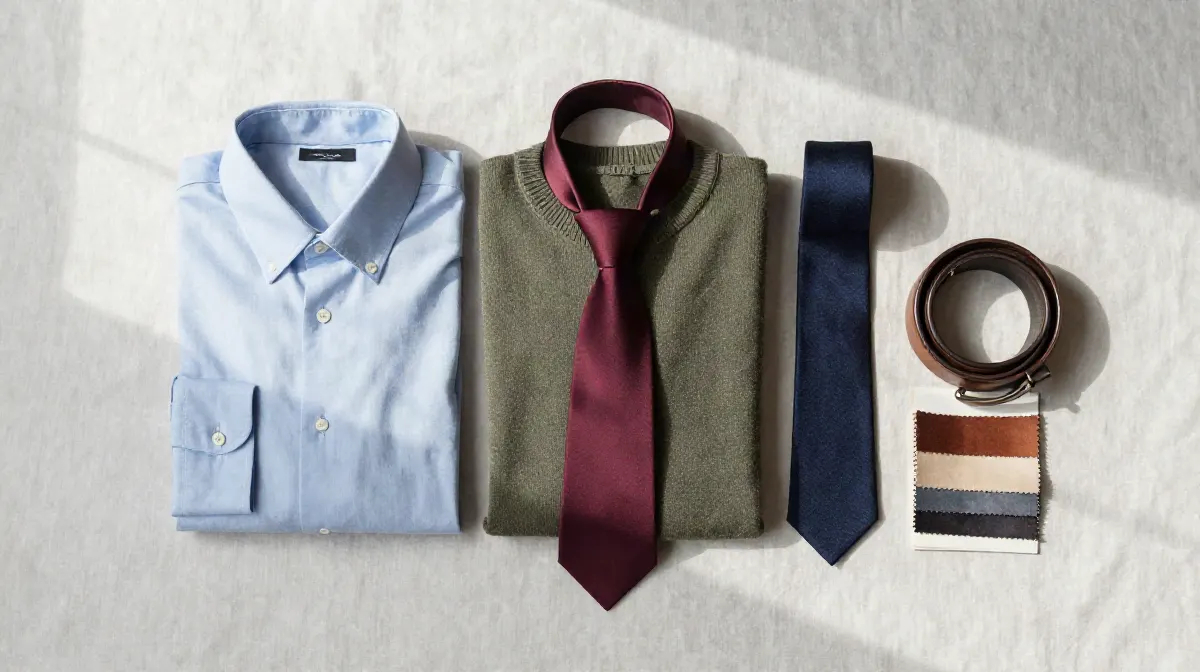
How the wardrobe colors are chosen
We take each season's neutrals and palette, about 25 colors, and measure every one for lightness and strength (chroma, how far the color is from gray). Then four rules pick three colors for each job. These rules are ours, a plain way to turn a palette into a men's wardrobe. They are not a study.
- Suits and jackets: the three deepest colors with a chroma of 35 or less.
- Shirts: the three lightest colors with a chroma of 35 or less.
- Ties, pocket squares and scarves: the three clearest colors that are not near white or near black.
- Knitwear and casual shirts: the three colors closest to a middle depth and a middle strength.
No color is used twice, and two colors in one group must look clearly different. A light season has no deep neutral. Light Spring's deepest quiet color is a mid-tone denim, so its suit list is lighter than a winter list. We show that as it is.
Do navy, black, charcoal and white suit your season?
The men's staples against all 12 palettes. A low number means a palette color is very close to the staple.
| Staple | Close (6 or less) | Near (7 to 12) | Far (over 12) |
|---|---|---|---|
| NavyMedian of 9 palette colors named like it |
|
| Light Spring, True Autumn, True Spring, Soft Autumn |
| BlackMedian of 3 palette colors named like it |
|
| Bright Spring, Soft Summer, True Summer, Soft Autumn, True Autumn, Light Summer, True Spring, Light Spring |
| CharcoalMedian of 4 palette colors named like it |
|
| True Autumn, True Spring, Bright Spring, Bright Winter, Light Spring |
| GrayMedian of 7 palette colors named like it |
|
| Bright Winter, Deep Autumn, True Autumn, True Spring |
| OliveMedian of 8 palette colors named like it | None |
| Soft Summer, Deep Winter, True Winter, True Spring, Light Spring, Bright Spring, True Summer, Bright Winter, Light Summer |
| WhiteMedian of 8 palette colors named like it |
|
| None |
For each staple we did not type a color. The reference is the middle value (the median, in CIELAB) of every color in the 12 palettes with that word in its name, for example all 9 navy colors. Then for each season we find its closest color to the reference with CIEDE2000, the standard measure of how different two colors look. Under about 2 you can barely see a difference. The groups at 6and 12 are our own cut-offs. Each small label gives the closest palette color and its number.
Black is a close match in 2 seasons (Deep Winter, Bright Winter). Navy is close in 2 (True Summer, Bright Spring). A staple that is far for your season is not banned. Wear it below the waist, or put a palette shirt between it and your face.
How to find your season as a man
- Stand by a window in daylight, with the light on your face. Take your hat off.
- Trim stubble that climbs the cheeks, or take the photo clean-shaven if you can.
- Take two or three photos in different light. The result uses the middle of them.
- Check what you read by eye: your undertone, your contrast level and what colors look good on you.
For outfits, each season has a page with ready looks, for example Soft Autumn outfits, Deep Winter outfits and Light Summer outfits. The guides list every article on this site.
What this page cannot tell you
- It cannot name your season. The wardrobe tool shows what each season's palette gives. It does not know your skin, hair or eyes. Only a measurement of them, or a draping session, can.
- It cannot read your beard. If a beard is much lighter or redder than your hair, hold your season colors next to your face and look.
- A screen changes colors, so the same swatch looks a little different on each phone. Cloth in a shop changes again under shop lights.
- A short test is not an exact one. How it works and how often it is right.
How this is different from other color analysis tools
- 01
Your photo stays on your device
Many photo apps upload your selfie and read it on their server (see our comparison). Ours measures it in your browser. There is no upload.
- 02
The result is free
Your season and palette, with no account and no email. At least one app in our comparison takes payment before you see any result.
- 03
A close call says so
Every result names the runner-up season and how close the call was. Borderline is a result we print.
- 04
We publish our accuracy
We tuned the method on faces that experts had labelled by season, then tested it on 410 celebrity photos we collected. The results, misses included.
Questions
Does color analysis work for men?
Yes. Color analysis sorts people by three things: undertone (warm or cool), depth (light or deep) and clarity (soft or bright). Those are the same for every person, so a man gets one of the same 12 seasons as a woman. Our analysis has no input for gender. It reads skin and hair from your selfie.
What is the difference between color analysis for men and for women?
The method is the same. What changes is how you use the result. A man wears fewer colors near the face (a collar, a tie, the neckline of a sweater), and he often has a short haircut or a beard. That changes how easy the hair is to read and which pieces carry your color. It does not change the seasons.
What colors should men wear for their skin tone?
Wear the colors of your season near your face and keep the others for trousers, shoes and belts. Skin tone alone does not give one season, because hair and eyes decide between the neighbors. Pick a season in the wardrobe tool above to see suit, shirt, tie and knitwear colors from its palette, or measure yours from a selfie.
Can I get a color analysis if I have a beard?
Yes. Our analysis reads skin from patches on the cheeks and forehead, and hair from a band above the forehead. It does not read the beard. If a beard or stubble climbs up the cheeks, it can change the cheek patches, so trim the cheek line or shave before the photo for the cleanest reading. If your beard is a different color from your hair, the number does not include it, so look at that by eye.
Does color analysis work if I am bald or shave my head?
Yes, with less to measure. With hair, the hair gives 55% of the depth reading. If the band above your forehead does not look clearly different from your skin, the analysis marks the hair as not readable and uses your skin alone for depth and clarity. Both are less certain then. The contrast level guide shows how to judge contrast by eye.
Do men and women get different seasons?
No. There are 12 seasons and every person falls near one of them, whatever their gender. A man can be a Soft Autumn or a Bright Winter, just as a woman can.
Is black a good color for men?
It depends on your season. Across the 12 palettes, black is a close match (CIEDE2000 of 6 or less) in 2 seasons: Deep Winter, Bright Winter. It is a near match in 2: True Winter, Deep Autumn. In the other 8 the closest palette color is a long way from black. In those seasons a deep navy, charcoal or brown suit usually sits closer to your coloring.
What color shirt looks best on me?
The shirt collar sits against your face, so it is the color that matters most. White is at least a near match in all 12 seasons, but it is a close match for 7 of them and warm seasons sit closer to cream or ivory. The wardrobe tool above shows the three lightest quiet colors of each season.
Can I wear a hat or glasses in the photo?
Take the hat off. Our analysis reads hair from a band above the forehead, and a hat covers it. Take glasses off too if you can, because frames can hide the eyes or cast a shadow on the face. Stand by a window in daylight, facing the light.
What you can do on this page
This page has an interactive wardrobe for men. A visitor picks one of the 12 seasons, or chooses "I don't know yet" to see all 12 side by side. For a season the page lists three suit colors, three shirt colors, three tie colors and three knitwear colors, each with a name and a hex code from that season's palette, chosen by fixed rules for lightness and strength. A second table compares six men's staples (navy, black, charcoal, gray, olive, white) with all 12 palettes by CIEDE2000. The page then offers the free photo analysis, which measures undertone, depth and clarity from one selfie in the browser, with no upload and no account.
Keep reading
- All 12 color seasonsEvery palette side by side
- Contrast levelLow, medium or high, and what it means for your colors
- What colors look good on me?Your best colors, by family
- Warm or cool undertoneFour checks you can do at home
- Soft Autumn outfitsReady looks for one season
- Deep Winter outfitsReady looks for the deepest cool season
- Skin tone chartSix depths, three undertones
- All guidesEvery article on this site